




關聯資料
更新日期:2019/11/19
更新日期:2019/11/19
This album of 36 views of Jehol comes from the Barberini Library, bound in a volume containing three Chinese fly leaves at the beginning and three at the end. The main body of the album consists of 36 views in copperplate engravings printed on Western paper, each sheet measuring 29.2 x 32.5cm (with an image frame of 27.2 x 30cm), is folded in the middle, and bound to a yellow silk cover. Each volume measures 31 x 17.4cm and features butterfly binding. Matteo Ripa was sent to China by Propaganda Fide in the context of the 'Chinese Rites Controversy'. Between 1711 and 1723, he worked as engraver to the Kangxi Emperor in Beijing, making for him copper engravings of 36 views of the Jehol summer resort. Thus, he introduced the European copper engraving technique into China. Ripa presented to Kangxi 70 copies of the printings, and perhaps he kept 30 copies for his personal use. He sent these albums as gifts to his relatives, to important people in the Church or States in Naples, England and France. During a visit to London in 1724, returning to Europe from China, he reportedly introduced a copy showing Kangxi's summer resort to Lord Burlington and his circle, including the landscape designer William Kent (1685-1748), who then introduced a new style of landscape gardening in England which was known throughout Europe as 'Jardin Anglo-Chinois'. The Vatican copy of the album is the second one that Ripa sent from China to Cardinal Francesco Barberini, his protector in Rome, after he had failed to send the first one. Numerous letters between Matteo Ripa and Barberini are preserved in the Vatican Apostolic Library, in which Ripa reports important affairs regarding the Chinese mission in general, and this album in specific. The following 13 pictures were selected from this Ripa's album.Reference:. YU D.C. (2013). Il Barb. Or. 147 e la corrispondenza tra Matteo Ripa e Francesco Barberini iunior. In Studi in onore del cardinale Raffaele Farina, II, Città del Vaticano (Studi e testi, 478), pp. 1321-1363. . RIPA, M. (1996). Giornale (1705-1724), introduzione, testo critico e note di Michele Fatica, vol. II (1711-1716), tav. I-XXXVI. Napoli.
Thirty-six Views of the Imperial Summer Palace at Jehol, 1714
Giulio Aleni, an Italian Jesuit, arrived in Macao via Goa of India in 1610 and later came to mainland China in 1613. He did missionary work in several cities like Beijing, Kaifeng, Nanjing, Hangzhou and in Fujian Province. He helped build as many as 20 churches and baptized more than 10,000 people, so he was praised as the 'western Confucius' by local Christians. When he was in Hangzhou city in 1623, Giulio Aleni studied Abraham Ortelius's Theatrum Orbis Terrarum and the works from Diego de Pantoja and Sabatino de Ursis, and then made Wan Guo Quan Tu (Map of the world) and compiled it to the book of Zhifang Waiji (Chronicle of Foreign Lands). The map was constantly reprinted and spread in varied versions. There are both monochrome and colored versions in Vatican Library, hereinafter referred as Version A and Version B, according to the shelfmarks. Version B consists of three parts in monochrome ink, with the first part as introduction, the middle part as Wan Guo Quan Tu, and the final part as two hemisphere maps of Bei Yu Di Tu (Map of the North) and Nan Yu Di Tu (Map of the South). While Version A covers the ink monochrome with colors, but removes the two hemisphere maps, with the introduction part and the final part left. Aleni employed Chinese conceptions of size and varied layers of 'Heaven' in order to elaborate geographical concepts and Catholic doctrines, with an attempt of breaking up the stereotypes of imperial centralism, and thus inspiring and establishing a new outlook of world among scholar officials in late Ming Dynasty. In addition to the names of the fifteen provinces, it is also included the four Chinese characters, '大清一統' (Da Qing Yi Tong , means unification of Qing Dynasty) on the inland places of the both versions. These four characters might prove the year of 1648 as a transitional period, when the army of Qing Dynasty established themselves in Fujian Province, and in the second year Aleni died. Interestingly contradicted, the two marine sections was both marked as '大明海'(Da Ming Hai, Sea of Ming Dynasty). In Bei Yu Di Tu (Map of the North) of version B, “大明一統' (Da Ming Yi Tong, unification of Ming Dynasty) was in the inland place, and Da Ming Hai in the ocean part. It thus could be presumed this engraved versions of Ming Dynasty were still in use in the early Qing Dynasty, being only partially modified. Reference:. 黄时鉴. (2011). 艾儒略《萬国全图》AB 二本见读後记. 黄时鉴文集3:东海西海, 东西文化交流史(大航海时代以来). 中西书局,273-280.. 邹振环. (2011). 晚明汉文西学经典 编译、诠释、流传与影响. 上海:复旦大学出版社, 255-288.
Aleni Map of all the Kingdoms of the World, A, B version, ca. 1648
The third picture is selected from Jesuit Giulio Aleni's Tian Zhu Jiang Sheng Chu Xiang Jing Jie (天主降生出像經解, explanations on the incarnation of the heavenly lord), an illustration book of Jesus Christ's biography from his birth to resurrection and ascension. Drawn in the year of 1637 (the tenth year of Emperor Chongzhen), the book uses the traditional Chinese crafts of woodcarving to represent the western images in illustrations. Learning from the method of western engraving to grasp the main features, the images bear great resemblance to the book of Evangelicae Historiae Imagines by Jerome Nadal. Regardless of the aversions from Chinese traditions, the image of crucified Jesus was engraved as half naked on the Cross. This preceding conflict reflected those changes of missionary strategies during the historic Anti-Christian Campaigns in the late Ming. Juliano Aleni remarked on the book to express forthrightly his purpose of mission in China as when people read the book, they feel like praising and worshiping Lord, with all words and all deeds. Due to the Fujian Anti-Christian Campaign in the year of 1637, Juliano Aleni was expelled from China to Macao, hindering Catholic missions in China. Vatican Library has four editions and ten volumes of Aleni's Tian Zhu Jiang Sheng Chu Xiang Jing Jie. This selected picture is from the wood-bloack print edition of Jinjiang Nestorianism Church (晉江景教堂) in Late Ming. Reference:. D'Arelli, Francesco. (1997). I libri cinesi di G. Francesco Nicolai, O.F.M. nel fondo Borgia cinese della Biblioteca Apostolica Vaticana. Archivum franciscanum historicum, 90, 526-532. . 莫小也. (2011). 17-18世紀傳教士與西畫東漸. 杭州:中國美術學院出版社. . 陳煥強. (2013). 明清天主教《聖經》故事版畫圖像敘事研究. 廣州:暨南大學. . 謝輝. (2015). 梵蒂岡圖書館藏艾儒略著作二種版本考略. 國際漢學, (3), 178-184, 205
Three Works on Annuciation, 16th-17th century (III)
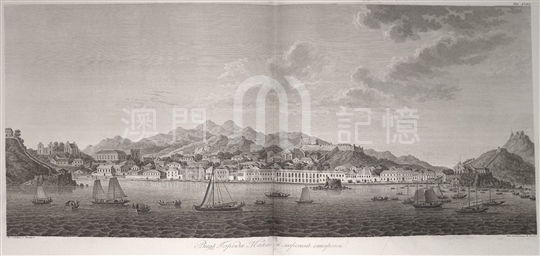
| 時間: | 清中期(1760-1844年) |
| 1813年 | |
| 關鍵字: | 海岸線 |
| 建築 | |
| 山嶽 | |
| 船舶 |
| 責任者: | 佚名(Anonymous) |
| 資料來源: | Vid goroda Makao s morskoĭ storony. V Sankt-Peterburgie, v Morskoĭ tipografĭi, 1813. |
| 數位作品提供者: | 澳門科技大學 |
| 權限範圍: | 澳門科技大學授權澳門基金會使用。如需使用有關資料,需徵得有關版權實體的同意。 |
| 規格: | 32 x 75 cm |
| 語種: | 俄文 |
| 製作日期: | 1813年 |
| 資料類型: | 圖片 |
| 黑白 | |
| 電子資料格式: | JPG, 3000x1421, 2.68MB |
| 登錄號碼: | p0001077 |
尊敬的“澳門記憶”會員,您好!
感謝您長期以來對“澳門記憶”文史網的支持與信任。為持續優化會員服務品質與保障會員權益,本網站將自2025年4月28日起正式實施新版的《服務條款》。敬請各位會員詳閱修訂後之條款,有關內容可於以下查閱:
您已詳細閱讀並同意接受該等《服務條款》修訂內容。
若您對本次更新有任何疑問,歡迎隨時與我們聯繫。
感謝您一如既往的支持與信任,“澳門記憶”文史網將持續為您提供更安心、便捷的會員服務。
“澳門記憶”文史網 敬啟
發布日期:2025年4月28日
使用說明
檢視全站索引
“AND”,為縮小檢索範圍,表示前後搜索項之間的 “交集”;
“OR”, 為擴大檢索範圍,表示前後搜索項之間的 “聯集”;
“NOT”,為排除不相關的檢索範圍 ,“AND NOT”表示第二個搜索項,在檢索範圍將被排除。
已經有澳門記憶帳號了? 登入
留言
留言( 0 人參與, 0 條留言):期待您提供史料和真實故事,共同填補歷史空白!(150字以內)